Search This Blog

Thursday, December 2, 2021

Graphic Content: Graveneye by Sloane Leong and Anna Bowles

 In the haunted house subgenre, it takes a special kind of book to stand out from all the other haunted house tales, both past and present. Graveneye by writer Sloane Leong and artist Anna Bowles definitely stands out as an original tale thanks to several unique aspects of its story and its medium. The fact that it’s a graphic novel is not the most unusual element of this tale of hunger and obsession, nor is it the fact that there is minimal dialogue in this piece. No, what makes this book stand out from all the other haunted house tales is the narrator, which is the house. Not a ghost in the house, but the house itself.

The story itself is actually conventional. Ilsa lives alone in her large mansion deep in the woods. Marie, the new housekeeper, knows there is something fascinating about the house and about its lone inhabitant. Brave, confident Ilsa is free to do as she wishes. Whenever she wants to hunt on her property, indulging in her bloody fantasies, she is able. Marie sees Ilsa’s freedom, as well as her confidence, and wishes she could live life as boldly as Ilsa. But Marie is too timid to escape the burden she is trapped under, and she does not realize the terrible secrets that Ilsa and the house keep hidden.

The house as a narrator speaks directly to the audience, not as something that was once human who has somehow become a house, but as a house that has somehow become sentient, a silent witness to the depravities of its residents. The house narrates not only as a dispassionate observer but also as an observer who only knows humanity from the strange actions it has seen as a house. Along with Leong’s strange narration of this Gothic tale, plus her eschewing of traditional dialogue, there is Bower’s artwork that sticks mostly to a black and white pallet, except when the scene calls for a visceral red. Haunted house stories sometimes sabotage their own scares by suddenly becoming loud to the point of being obnoxious. Leong’s show of restraint establishes tension that Bower’s minimalist art style only magnifies with its depiction of cold and colorless rooms nevertheless teeming with shadows and secrets. The house, the reader discovers, is the right person to tell this story. It has studied the past of where it was built, who has lived in it, and it’s as implacable as any structure designed to stand for hundreds of years.

Stream to Scream: Horror Noire and Ghost Summer


Horror often puts a supernatural mask on our own very real fears, exploring our own very real phobias through a narrative that we convince ourselves is trapped in its pages and can’t escape them once the book is closed. And we can also close the newspaper, turn off social media, but that news, and the consequences of what’s happening, is still out there. Many times, horror often creates a more palpable way to consider and even discuss these real world terrors by putting them in the guise of a killer clown of vengeful spirit. A master of this is Tananarive Due, who has not only written scholarly works on the genre, but is also an accomplished author of horror fiction. Her skills in relevant and revealing storytelling are revealed in the anthology movie Horror Noire and in Due's short story collection Ghost Summer.

Following up on the Horror Noire documentary that looks at the many black voices in horror, this anthology that shares the same name features six supernatural stories that explore contemporary societal issues and monsters that may or may not be supernatural (the first entry “The Lake” is a prime example of this). The stories run the gamut from Southern Gothic tales like “Bride Before You” and more comedic horror fare in “Sundown.” As with many anthology stories, the quality of the tales can be uneven, with “Brand of Evil” and “Daddy” being some of the lesser quality ones, but all the stories do evoke a moral  in a way that doesn’t sound pedantic, which is a true accomplishment in storytelling.

Ghost Summer is an obvious collection to link with this movie anthology because Due’s story “The Lake” can be found at the beginning of the book. While “The Lake” tricks the reader into sympathizing with the monster who is also the protagonist, stories like “Summer” explore how our own emotional burdens can create monstrous thoughts. There are also stories that look at the pervading effects of America’s history of racism. The story “Ghost Summer” excavates the consequences of a town’s brutally racist past with a breezy coming-of-age tale about a boy determined to discover ghosts on his grandparents’ property. “Free Jim’s Mine,” on the other hand, is a historical tale that explores how freedom can come with a very terrible price. “Trial Day” explores what black people in the racist South to be if not accepted then at least tolerated. Due’s fiction and Horror Noire both explore darker parts of our history that might make some people uncomfortable, but the fact that these feelings and attitudes are still rippling across current events means they are still worth tackling.

Sunday, November 14, 2021

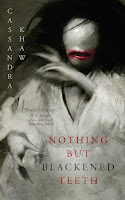
New Arrival: Nothing But Blackened Teeth by Cassandra Khaw


Many horror fans are probably familiar with the image of Samara, the creepy ghost girl from The Ring, crawling out of the television, her damp, black hair forming a veil across her face. They might not know that she originally appeared in the movie Ringu and in the novel by Koji Suzuki. They also might not know that, in the novel, her name is Sadako Yamamura and she is the vengeful spirit, or onryo, of a young woman who was murdered and thrown into a well. However, there are also fans of J-Horror films and stories who are quite aware of Koji Suzuki and other creators in this subgenre. Fans of those stories will be delighted to know that Cassandra Khaw’s Nothing But Blackened Teeth expertly uses Japanese mythology and spirituality, as well as some down-to-earth human ugliness, to tighten the screws on some adult friends who just wanted to attend a wedding in a haunted mansion.

Those who have seen a few horror movies already know that having a wedding in a mansion that’s supposed to be haunted is a terrible idea, but it doesn’t stop four friends from planning a wedding there. Nadia and Faiz are there to tie the knot, while Phillip is the friend from old money who has made this wedding possible. Relating these events is the semi-reliable narrator Cat, recently recovered from depression and disliking her best friend Faiz’s new bride (the feeling is quite mutual). Throw in Lin, the comic relief that the friends don’t really find funny, and you have a group that are basically fodder for the ghost bride that is happy to finally have some living guests at her mansion.

This novella is a quick and brutal read but Khaw’s gift for description paints a vivid picture of the supernatural terrors that borrow heavily from Japanese folklore. Throwing around terms like yokai and kitsune might confuse some readers, but Khaw not only provides enough context to keep the readers in the story, she demonstrates a knowledge of these terms that grounds the story in if not reality then authenticity. The characters trapped in this nightmare might not be ones the reader would like to spend time with, but they will want to see what happens to them as the story progresses to a violent and even heartbreaking end. Nothing but Blackened Teeth is an example of a novella that showcases why this medium shines at telling horror stories, providing the depth of a novel with the pace that quickens the readers’ heartbeats. It also is the perfect novella for J-Horror fans that want to delve into its particular brand of mythology.

Graphic Content: Abbott and Abbott 1973


Urban fantasy and paranormal romance, including works by Jim Butcher and Patricia Biggs, are two speculative subgenres that often get lumped together. And just like chocolate and peanut butter, they create something better than the sum of their parts. Rather than dissect these stories for the elements that are either urban fantasy or paranormal romance, the meager taken up with this review would be better spent enlightening readers about a pair of graphic novels that are not only a great example of both urban fantasy and paranormal romance but contains some social commentary into which readers can sink their mental teeth. These two graphic novels are Abbott and its sequel Abbott 1973, both written by Saladin Ahmed and illustrated by Sami Kivelä.

Abbott introduces the reader to chain-smoking, tough as nails Elena Abbott, tabloid reporter with an acerbic wit, a need to always be smoking, and a supernatural destiny that piques the interest of the dark forces brewing in Detroit. In Abbott, Elena must battle a secret society with close ties to the Umbra, a literal force of darkness that wants to destroy the world. The first book introduces the reader to Abbott’s world and its colorful characters, some who don’t make it to the end of the first story. In Abbott 1973, after learning more about her destiny and enjoying a new relationship, Elena must find out who or what is trying to interfere in Detroit’s mayoral election. Elena and her friends must battle not only the agents of the Umbra but also the racism and corruption that flow through Detroit’s streets like poison.

Those who like hard-boiled noir, ‘70s cop shows, or urban fantasy will find something to like in Ahmed’s story. Elena features prominently in every panel, always smoking and rarely smiling. Elena might not have a lot to smile about, particularly when it comes to her status in this version of the Motor City. Elena has lost lovers to threats both mundane and paranormal, and she faces racism as well as sexism in her job as a reporter, but these struggles are what make her an interesting character as well as someone to whom modern readers can relate. Kivelä’s artwork helps immerse the reader in Elena’s world, not only by invoking the fashion and aesthetic of the ‘70s but by using an art style that brings to mind early ‘80s Vertigo comics. These books are for fans of The Dresden Files as well as the Mercy Thompson series, but they also display a social awareness in its depictions, for example, of racism among Detroit’s police. This look into deeper, darker issues that aren’t supernatural helps set it apart from the many heroines of this genre that are both witty and tough as nails.