Search This Blog

Thursday, June 17, 2021

New Arrival: The Razorblades in My Head by Donnie Goodman


 For me, a good horror story doesn’t have to necessarily be straight-up terrifying or even subtly disturbing. Sometimes, I need a story to just be crazy. Horror, indeed any speculative fiction, can implement a very outlandish premise, one conceived in a state of inebriation or simply shooting the bull with friends, can be turned into an enjoyable and engaging story with the right amount of human emotion. This is the case with the stories in Donnie Goodman’s debut story collection The Razorblades in My Head.

The title of this collection is very fitting, and not merely because there is a story in this collection with that very title. Each one of these stories are little slices of short story goodness that cut surprisingly deep, largely because the concepts are so original, hinting at Goodman’s bravery to try something that, as the old cliché goes, is so crazy that it just might work. “Toaster” is a brief, slice-of-life story with a poisonous sting.  If you thought the movie Jack Frost could be terrifying (frankly, both the Michael Keaton family pic and the silly killer snowman premise both have the potential to be terrifying), then “Magic in the Hat” might deliver some winter chills. Do you find that there’s not enough pro wrestling in horror, or vice versa, then give “The Stranger in the Squared Circle” a read and discover how much of a wrestling fan Goodman is. Are you a fan of noir, cosmic horror, or killer crustaceans? Then check out the terrific “The Old Bay King,” which delivers shady characters that would do Joe Lansdale proud.

Seeing that this is a self-published collection, it’s my hope that this collection raises Goodman’s profile. If anything, this collection has stories worthy of being snapped up by any publisher who has a wrestling or oceanic anthology. Here’s hoping Donnie Goodman keeps writing and keeps getting his work out there. I look forward to his next collection to see what other kinds of wild ideas he has brewing among the razorblades that are swimming in his skull.


Monday, June 7, 2021

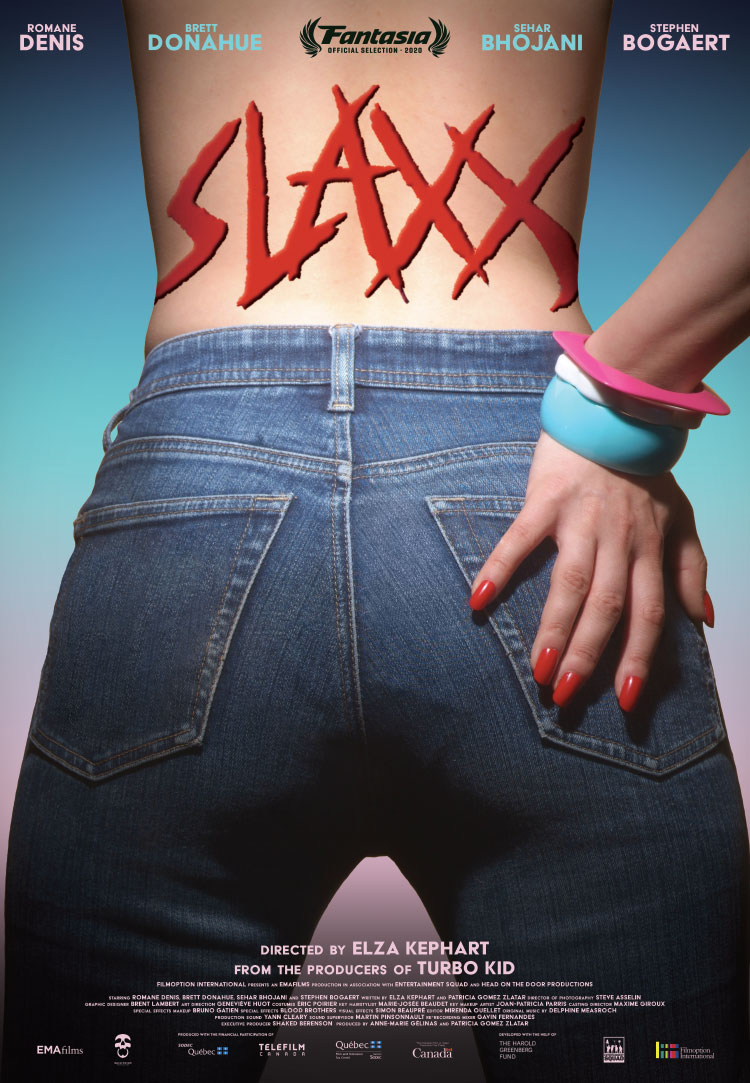
Screen to Scream: Slaxx and Horrorstör


Work is something to which we devote most of our lives. This is because work provides money, and money is required to live in modern society. The desire for money and the necessity of a job can create a vicious cycle, especially if you feel that your job is tedious or meaningless, and horror always uses everyday stresses in our life and then amplifies them into something horrific. But we are also working for more than just the bare necessities. If anyone reading this has lived through the ‘80s (and watched, for example, John Carpenter’s They Live) know that horror often has a lot to say about societal trends like consumerism and how our desire for the nicer things in life locks us into a lifestyle we don’t want. In other words, to quote David Byrne, you make ask yourself, “How did I get here?” (another shoutout to the ‘80s kids). The movie Slaxx and Grady Hendrix’s book Horrorstör both look at some truly hellish workplaces.

Slaxx has a very out-there premise: a possessed pair of jeans goes on a killing spree while a trendy store is in lockdown. Before the big premier of Super Shaper jeans, Libby McClean is hired to work at Canadian Cotton Clothiers (CCC), a trendy clothing store, which is also Libby’s dream job. Libby is an idealistic teen who is ready to help CCC deliver its message of sustainable, ethically responsible, and attractive fashion, but after meeting her fellow workers, like insufferable boss Craig, and learning what the store is really about thanks to said possessed pair of jeans, that idealism is shattered. Some say that the tearing down of one’s idealism, at least that person’s loftier ideas, is a fundamental part of growing up, but Slaxx is also a movie about a nasty aspect of consumerism: a company’s message may be quite different from its actual practices, especially in the service of monetary profit.

If Slaxx depicts the death of idealism, then Horrorstör is the exhumation of its corpse. Amy is unhappy with her job at ORSK, a furniture store that sells minimalist furniture and is no way related to IKEA (it totally is IKEA). Amy sees her job as a dead-end job and sees her manager Basil as a wannabe corporate tool. When a few coworkers suggest Amy and Basil stay with them overnight to see who is trashing the store at night, what seems like an interesting diversion to Amy becomes a haunted and harrowing night. Yes, the ghosts in this store are terrifying, even as the book dives deep into its IKEA satire. However, the book also looks at the fear Amy feels of her life being stuck working in a job she hates, something that many people can relate to. She might want to get off the hamster wheel that many feel strapped into once they reach adulthood, but she doesn’t know how. The ghosts haunting ORSK are into torture, as well as the importance of work and discipline, but Amy’s torture began long before she stayed overnight in ORSK. It was when she realizes her complete lack of direction in life. During the night she spends in ORSK, the dial was cranked up all the way and then ripped off. Horror lovers should love both these stories if they have a job they don’t like, or if they’ve ever escaped one.


Have You Read This? The Raven by Jonathan Janz


If every kind of story has already been done, then horror has yet to get the memo. Perhaps more than other genres, horror takes tropes and ideas that once oversaturated a market and make them seem fresh and intriguing. If you’re a werewolf, vampire, or ghost that dreams of getting their moment in the moonlight, it’s possible to simply hibernate a few years, wait till everyone’s moved onto something else and then come back strong. If you’re a story about the apocalypse, for example, you wait until the mania for The Stand and The Walking Dead has died down before returning to the forefront (especially in a world that currently seems like a dumpster fire full of burning, dirty diapers). Johnathan Janz has taken this philosophy to heart, while also applying the kitchen-sink method of worldbuilding, to create his new post-apocalyptic tale The Raven.

The Raven takes place after a DNA-altering virus is unleashed upon the Earth. Not only does this create people with X-Men style superpowers, it also creates some very unique monsters pulled from myth and legend, including but not limited to vampire, werewolves, and satyrs. Thrown into this world is Dez, a survivor who also happens to be a Latent, one who has no powers nor is a monster. With crossbow in hand, he scours the land to search for his lost love as he encounters a series of monsters (some human and some more than human) who see him as weak prey.

Credit to Janz for taking a premise that puts several genres into a blender to create this dystopian smoothie, heavily seasoned with Spaghetti Western. Dez is, however, not the typical steely badass that Clint Eastwood was in his movies, but rather a man trying and failing to make sense of a new world where he’s been bumped down several notches on the food chain. The book contains mostly random encounters with some of these monsters, but it does culminate in a bar fight that could be an illustration of an X-Men movie written by Robert Rodriguez and directed by Quentin Tarantino. The novel seems like a gigantic hodgepodge at times, but there are also some moments of brilliance, such as the barfight, and scenes which demonstrate this strange new world’s moral gray areas. The book tends to buckle under the weight of exposition at times, but it also provides a great set-up for an expanded universe, if Janz decides to go that route. He’s already laid the necessary groundwork in this book, but subsequent books could really let this premise soar.

Monday, May 17, 2021

Have You Read This? Good Neighbors by Sarah Langan


One of my favorite horror podcasts is This Is Horror. One of the things I love about it, other than their ability to get all the top names in horror to come and talk about the genre, is the entire premise behind their name. The name This is Horror implies that horror doesn’t apply to works that fit into a very specific criteria (“This is horror,” they might say, or “that is horror”). Their widening of the genre definitions has allowed me to notice and review an excellent book, Sara Langan’s Good Neighbors. While it might be missing the vengeful spirits and wholesale slaughter of many horror novels, the book showcases a particular breed of monster: the human being in the throes of groupthink.

If traditional horror has taught its consumers anything, it’s that the most innocent sounding street names (looking at you, Elm Street) will be inverted from a suburban utopia to a maddening dystopia, and Long Island’s Maple Street is no exception (although it could also be a nod to the Twilight Zone episode “The Monsters are Due on Maple Street,” which is its own tale of suburban paranoia). The Wilde family, including former rock star Arlo and his former-cocktail-waitress wife Gertie, have entered suburbia and discovered a slew of neighbors that seem welcoming at first, particularly alpha neighbor Rhea Schraeder. But a sinkhole appears in their neighborhood just as a malignant rumor springs to life among the neighbors. What follows for the Wildes and the neighbors of Maple Street is a descent into paranoia and madness beginning with accusations made and ending with an American tragedy that has seared itself into the consciousness of those who have the misfortune to live in Langan’s fictional universe.

Langan’s novel is a masterclass in using multiple storytelling techniques, particularly epistolary fiction, to build tension while keeping the story moving. There’s the crime podcast/documentary feel as Langan incorporates interviews, book excerpts, and even the mindset of actors who will play those who have become infamous thanks to what happens in the story. The knowledge that this pretense of community will all unravel hangs over the story, even as the characters, the likable if flawed protagonists and the unlikable hypocritical antagonists alike, are drawn into the story’s gravity, much like the kids of the story are drawn to the sinkhole. The environmental message seems tangential, mere window dressing to add strangeness, but Langan also interjects some pointed commentary about how stories have multiple viewpoints fed by multiple kinds of media. Even as she offers different points of view of how the horrors on Maple Street unfolded, she never flinches from the roiling emotions and slithering insecurities that make these characters both frightening and all too human.

Have You Read This? To Be Devoured


Some horror stories are a rumbling bulldozer, not meant to break any land speed records but designed to crush the reader with its emotional power. Stephen King has written many of these, and for me, the end of stories like IT and The Shining left me feeling like the end of a long journey, battered emotionally but somehow getting stronger for the experience. Then there are novellas and novelettes that are more like high-performance race cars. They go fast and drag you screaming along for the ride. Often able to read in one sitting, these can be true white-knuckle experiences where the reader finally breathes once the book is closed. One such novella that pulls readers along for a horrifying ride is Sara Tantlinger’s lean-and-mean novella To Be Devoured.

The book certainly has an odd but interesting premise. Andi, a young woman in a committed relationship, is trying to work through her various mental issues. Having experienced a great deal of death in her young life, she seeks to be normal for the sake of her girlfriend, but she also becomes fascinated with the vultures that she sees gathering over carrion, which reawakens her fascination with death. Andi must soon decide if she can resist these urges to live as the vultures do, including their appetite for the dead, or will she give in to them?

This story benefits from its slimness, keeping the focus on Andi’s POV as her life spirals out of control. How Andi views life, especially as she begins to lose her grip on sanity, is both beautiful and grotesque. There are indeed moments of profound horror and stomach-turning depictions of viscera and violence, but one still has to marvel at Tantlinger’s approach to depicting seemingly taboo violence in a way that rivals Clive Barker, particularly as the story flirts with body horror. To Be Devoured has no intention of overstaying its welcome as the reader reads, rocketing the reader through Andi’s descent into madness while making sure the reader is given the opportunity to assimilate every visceral detail. There is something refreshing to this bare bones approach to horror, the speed of how the reader reads through a work like To Be Devoured mimics the same fast tempo of the reader’s heartbeat. For those horror fans who want their horror more like roller coasters than bulldozers, they should give To Be Devoured a try.

Wednesday, April 14, 2021

Screen to Scream: North American Lake Monsters and Monsterland


 Some people prefer their horror to be all about extremes, visceral, gory, taboo-breaking extremes. More like heavy metal concerts from the back of Halloween stores, this view of horror, often pegged into the splatterpunk or extreme horror genres, wants to go right for the reader’s jugular or take a sledgehammer to the reader’s brainpan. Those new to horror might even think that this extreme horror encapsulates all of horror, but horror, like other genres, is a spectrum. One of the subtle differences between horror subgenres is the level of violence. There is actually some horror that relies not on dismemberment but disquiet. Disquiet horror relies more on making the reader uncomfortable rather than outright offending their sensibilities. If splatterpunk is heavy metal, then disquiet horror is classical music where the violin strings are the reader’s taut nerve endings. Writer Nathan Ballingrud may be one those writers whose name will become synonymous with disquiet horror, particularly since he has not only a collection of short stories, North American Lake Monsters, that all feature these kinds of slow burn stories, but this collection has also influenced a series on Hulu called Monsterland.

Monsterland is a unique limited series on Hulu in that it’s an anthology series. There are eight unique supernatural horror stories, each with a title denoting a particular US city. Some of those stories are even connected, particularly those that were created by Ballingrud for the series. So at least some of the stories in this series all share one story universe, a universe where mermaids are both an amazing catch and an omen of doom and where getting away from your problems is as easy as slipping off your skin, metaphorically and literally. In Ballingrud’s horror universe, these cities can be just as much of a character as the people who inhabit them, particularly those that take place in Louisiana. Much like in the Hulu movie Wounds, which is also based on Ballingrud's work, New Orleans is both vibrant and dark and as distinctive from other cities as the monsters, both human and supernatural, are distinctive from their victims.

The stories in North American Lake Monsters have some differences from Monsterland, even those that directly inspired specific episodes. Readers looking for some great examples of quiet horror should experience both the book and the series. Reading the fiction that inspired them, the supernatural monsters in this world often pale in evil to the all too human ones, and that can be more horrifying. At least, a vampire or skin-wearing monster is evil because that is its nature, specifically made to terrorize humanity. Humans being terrible to each other destroys the illusion that we are intrinsically better than any evil we will face. The characters in Ballingrud’s fiction voice some dark ideas and make terrible decisions that seem okay in the short term. In other words, they’re allowed to be just human enough to move down the slippery slope into depravity. With the goal of quiet horror being to make the reader uncomfortable, perhaps even nauseous from the circumstances it described, Nathan Ballingrud is set to corner the market on quiet horror.

Have You Read This? The Children of Red Peak by Craig DiLouie


People might say horror and religion go well together (particularly among atheist and/or agnostic horror fans), but I personally feel that such a statement is too reductive. When religion is brought into horror as a horrific element, it is often more about fanaticism. Sure, in the Bible, Abraham was ready to sacrifice his son Isaac because God told him to, a parable about loyalty to God, but if Abraham were to sacrifice his son today, Abraham might be not only the subject of a true crime podcast but an example of the dangers of blind obedience. When does faith become dangerous? When does God, or a god, demand too much of us mortals? Such crises of faith, liberally sprinkled with some human trauma, are explored in Craig DiLouie’s novel The Children of Red Peak.

The story begins with a mystery. In the mid aughts, the Family of the Living Spirit, led to Red Peak by the charismatic Reverend Peale, vanish off the face of the earth. A few of their children survive and grow into adulthood, but they are also burdened with trauma, trauma that has defined their adult lives. David works to get people out of cults, but he is himself trapped by his trauma. Deacon is a musician that seeks to use music to express his trauma as well as keep the psychic wound fresh. Beth is a psychologist who helps others, but all the self-medication and theories of the mind leave her wanting. Emily simply decided to stop fighting, and it is the suicide and subsequent funeral that brings the survivors together to try and put the horrors of Red Peak behind them.

The narrative of the story moves back and forth between the past and present. Readers will see how David and his family enter the Family, experience in graphic detail the events at Red Peak, and journey with the survivors as they all try to discover the mystery. DiLouie moves back and forth between past and present, moving among multiple survivor’s points of view, but readers can still follow the thread as well as the themes of faith, trauma, and the daunting meaning of existence. It would be one thing if this was just about some delusional cultists who were led down a dark path, but some of the best horror in this novel comes from DiLouie asking what if those cultists who committed horrific acts in the name of a deity were right? This is definitely a novel for those who like their horror existential, but it may be a surprise gut punch for those simply looking for a deep dive into the dangers of groupthink.